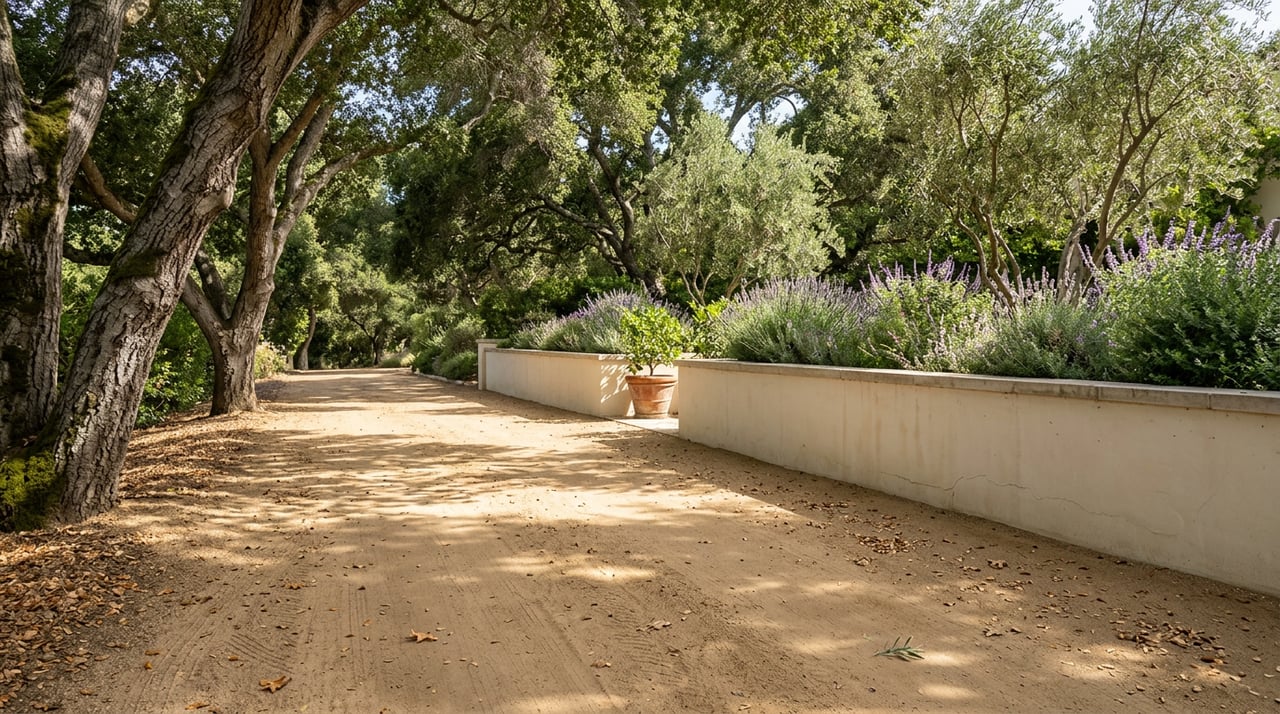
Inside the wrought-iron gates at Las Palmas and Marina, the calendar moves differently. A resident's July is not organized around downtown Santa Barbara, the airport, or Upper State. It is organized around three private systems that overlap on a single 1,863-acre map, and one stubborn geological quirk that answers to none of them.
The thesis, in one sentence
The character of a Hope Ranch summer is not the coast, the country club, or the trails in isolation. It is the way the Homeowners Association, the Riding and Trails Association, and La Cumbre Country Club braid together across the same week, sharing members, easements, and afternoon light, while the seaside bluffs occasionally send up a plume of smoke to remind the neighborhood that the land keeps its own schedule.
Everything below is evidence for that claim.
What "private" actually buys here
Most Santa Barbara neighborhoods share their coast, their trails, and their courts with the public. Hope Ranch does not. That single distinction shapes how a summer Tuesday looks from a Roble Drive kitchen window.
| System | What it governs | Access |
|---|---|---|
| Hope Ranch Homeowners Association | Private roads, 24-hour patrol, Hope Ranch Beach | Residential keycard |
| Hope Ranch Riding & Trails Association | Roughly 22 to 27 miles of bridle paths, arena, turnout areas | Property owners, members |
| La Cumbre Country Club | 18-hole course, six plexi-pave tennis courts, aquatics, fitness center, dining | Club membership |
Only three roads into the community are public. The rest, along with the beach, the bridle paths, and the club, run on their own membership rolls. A resident's summer routine is essentially a schedule of which key opens which gate on which afternoon.
The bluffs write their own calendar
On the morning of April 23, 2026, Santa Barbara County Fire crews were called to the seaside cliffs after residents reported plumes of smoke. The department logged the call at 10:26 a.m. and later confirmed a smoldering fire inside an underground drainage pipe. No structures were threatened. The crews stayed on scene until the burn was fully extinguished.
Locals have a nickname for it. Fire spokesperson Michael Gray told the Santa Barbara Independent he had always simply accepted it as the "Hope Ranch volcano," and that the department's practice is to monitor until it stops. Battalion Chief Adam Estabrook has previously described the mechanism in more careful terms: friction within the shale generates heat, naturally occurring oil serves as fuel, and cliff erosion introduces oxygen. It is closer to a solfatara than a volcano, and it has flared in 2017, 2019, 2020, 2021, and again this spring.
For a resident, the takeaway is less dramatic than the headline. The bluffs are a working piece of geology, not a hazard event. But they are also a small reminder that the coast side of the neighborhood is a landscape still in motion, and that the walking route below More Mesa is worth checking against the county's alert feed before an early June stroll.
The trail network as connective tissue
The bridle paths are the least visible of the three private systems and, functionally, the most important. They pre-date most of the homes.
The Hope Ranch Riding and Hunt Club was organized in the 1920s, co-founded by Amy DuPont and Harold Chase, with a clubhouse commissioned from architect Reginald Johnson. That founding logic still governs the community's grain. Parcels were laid out to complement the natural topography rather than fight it, which is why the trails read as continuous even as they cross private property lines.
Today the Hope Ranch Riding and Trails Association maintains close to 27 miles of paths through oak, along ridgelines, and down toward the shore. Sources vary between 22 and 27 miles depending on which spurs are counted, but the practical figure for a resident is the same: on a summer afternoon, a rider can leave a barn on Via Esperanza, wind through the interior, and let a horse drink at the shoreline without touching a public road.
A weekday routine tends to shape up along these lines:
- Early ride out of the interior barns before the marine layer lifts
- Late morning break at the beach cabanas for a swim
- Lunch on the La Cumbre terrace or a quick brunch outside the gates at Boathouse at Hendry's Beach
- An afternoon tennis or pickleball session at the club
- A cooler-hour walk on the trails once the sun drops below the ridgeline
None of the transitions require a car. That is unusual for Santa Barbara County at this price point, and it is the closest thing the neighborhood has to a competitive advantage over its Montecito peers.
La Cumbre in July
The club sits on the inland border of the property, its greens threading around Laguna Blanca Lake. The clubhouse was designed by George Washington Smith, whose Spanish Colonial Revival vocabulary sets the aesthetic default for the entire South Coast. The 18-hole course is a Captain George Thomas layout, which places La Cumbre in the same architectural lineage as Bel-Air and Riviera Country Club in Los Angeles.
The summer program leans heavily on outdoor dining, aquatics, and tennis on the six plexi-pave courts, with the recently added fitness center absorbing what used to be an off-season lull. Laguna Blanca Lake, which lends its name to the private Laguna Blanca School whose Middle and Upper campus sits within the enclave, is the visual centerpiece from the terrace.
For a resident, the club's real role in a summer week is not the golf. It is that it functions as the community's living room. A meeting that would happen at a restaurant elsewhere happens on the terrace here, which is why membership rolls and homeowner rolls overlap so heavily.
Hope Ranch Beach and the summer traditions
The gated beach entrance on Las Olas Drive is the neighborhood's most photographed threshold. Behind it, the setup is closer to a small private club than a public shoreline: lifeguards on duty in the summer months, staff who help set up chairs and cabanas, and historic on-site bathhouses with lockers, showers, restrooms, and kayak and surfboard storage.
Two annual traditions anchor the calendar:
- The HRHA summer beach party. Hosted by the Homeowners Association at intervals through the warm months, with beach volleyball, sandcastle building, and surfing. This is the one afternoon a year when nearly every keycard in the neighborhood is used in the same three-hour window.
- The Family Beach Camp-out. A summer overnight that has become the community's signature social event, and the reason a certain generation of Hope Ranch kids can navigate the sand at night with their eyes closed.
The beach is technically accessible at lower tides from the public beaches on either side, so the privacy is a matter of gate, patrol, and amenity rather than of legal exclusion. For residents, the distinction matters mostly in July, when the difference between a staffed cabana and a self-serve stretch of sand is the entire point.
Reading the summer
Put the three systems on the same map and a pattern emerges. The HRHA controls the perimeter and the coast. The Riding and Trails Association controls the interior corridors. La Cumbre controls the social and dining anchor at the inland edge. Together they explain why a Hope Ranch resident's week is unusually self-contained, and why the neighborhood tends to feel quieter in August than the calendar would predict. Most of the movement is happening inside the gates.
The Hope Ranch volcano is the exception. It is the one thing in the neighborhood that no association can permit, schedule, or gate. That is worth remembering the next time the bluffs steam. It is also, quietly, part of what makes the property here worth what it is worth. Land that still behaves like land is scarce on this coast.
Making the most of the season
For homeowners who want a considered take on how a Hope Ranch summer intersects with the broader Santa Barbara market, or who are simply curious what a neighbor's estate might carry in today's climate, Marsha Kotlyar Estate Group is available for a private conversation. Contact us at your convenience.